
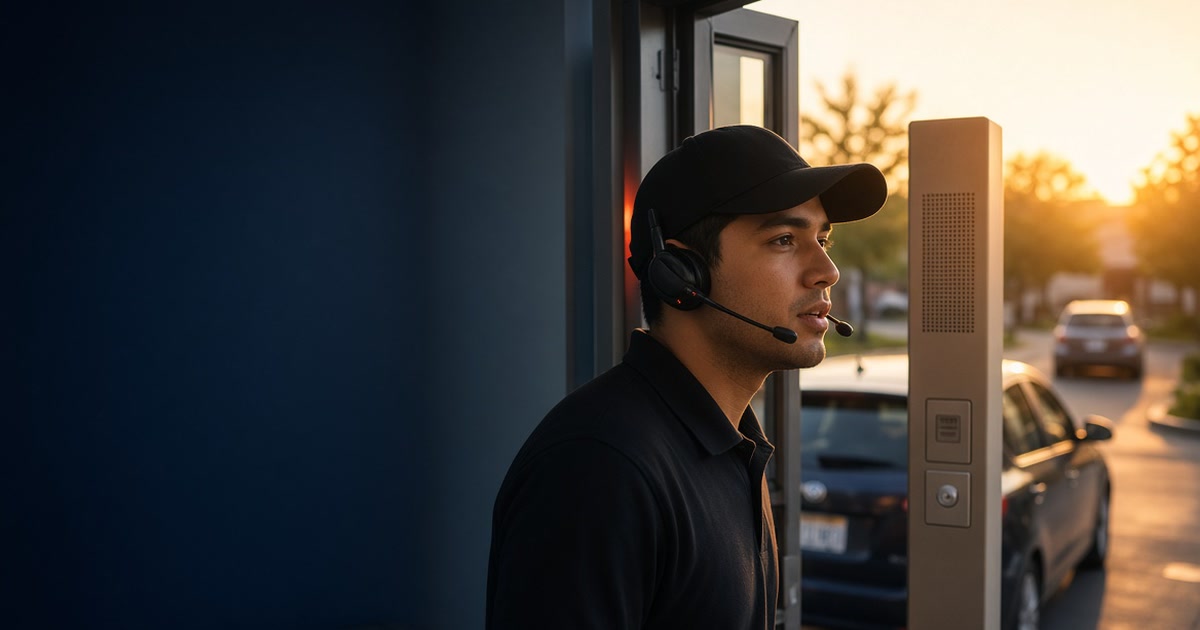
If you run a quick-service restaurant, you already know the math. Drive-thru is not a side window. For many QSR, coffee, and fast-casual concepts it is the majority of the day’s sales. When the headset system drops it means no greeting, no audio, no alert tone. The lane does not “slow down.” It stops converting cars into tickets.
This week one of our operator partners saw that happen. The store called the manufacturer first. They were told a dispatch was required. After the site reached C&T Solutions, our team walked them through the problem on the phone. The fix was a power cycle of a controller at the speaker post. The system came back up. No truck. No overnight parts. No lost lunch rush waiting on a technician who was not needed.
We represent strong brands that build strong products. That is not the debate. The debate is what happens in the first 20 minutes after the lane goes down and whether the person at the manufacturer support on the other end of the phone is motivated to exhaust remote troubleshooting before they schedule a visit.
What a drive-thru headset system actually is
A drive-thru headset system is not just “the thing on the crew member’s ear.” It is a two-way communication platform that ties the customer at the order point to the people taking, cooking, and handing off the order.
In a typical QSR install, five pieces have to work together:
- Vehicle detection. A loop in the pavement or a sensor at the pad tells the system a car is present. That trigger opens the audio path and plays the alert tone in the headset.
- Speaker post (order point). The outdoor microphone and speaker where the guest talks. Many posts also house a small controller or amplifier that conditions power and audio. That box is often the quiet culprit when “the whole system is down.”
- Base station. The indoor brain. It converts the wired audio from the post into the wireless signal the crew hears, manages lanes, registration, volume, and on current platforms like HME NEXEO | HDX -system health on a touchscreen.
- Headsets and batteries. All-in-one or beltpac units the crew wears all shift. Dead batteries, dirty mics, and unregistered units look like “the system is broken” when they are not.
- Timers and related hardware (optional but common). Speed-of-service timers, greeter messages, and now voice-AI ordering all ride on the same audio path. If the post or controller is wedged, those extras fail with it.
HME is the long-time specialist in this category. Current platforms include NEXEO | HDX (the flagship digital system), EOS | HD, and older ION / Wireless 6000 installs that are still running in a lot of stores. PAR, Panasonic, and others compete in the same lane. C&T Solutions sells, installs, and services multiple brands: HME, 3M/PAR, Panasonic, because operators do not all run the same stack, and a down lane does not care whose logo is on the base station.
Why “we need a dispatch” is often the wrong first answer
Manufacturer support lines exist to protect the product and the warranty process. That is a legitimate job. It is also a job that, in practice, defaults to a conservative path: if the store cannot prove the issue in two or three scripted steps, schedule a technician.
A restaurant partner who lives in these systems every week has a different incentive. We would rather keep the lane open in the next ten minutes than book a visit that may only confirm a power cycle, a tripped setting, a dead battery bank, an override left on, or a controller that needed to be reset at the post.
That is exactly what happened today. They did the reasonable thing and called the manufacturer. The manufacturer told them a dispatch was needed. Once the site reached us, we stayed on the phone, isolated the symptom to the speaker-post side, and walked them through a controller power cycle. Full operation returned.
To be clear: Our manufactuers makes a strong product. Their support line, however, often defaults to dispatch instead of more thorough remote troubleshooting. That gap is why this post exists and why we ask operators to make us the first call, including sites that did not buy the system through C&T Solutions.
What “down” usually looks like and what it often is
Most drive-thru audio failures cluster into a short list. Knowing the pattern helps a manager describe the problem in a way that gets a real diagnosis instead of a ticket number.
| What the store sees | What it often is |
| No alert when a car pulls up | Detector, loop, or base left in override / speed-team mode; post controller locked up |
| Crew can hear the guest, guest cannot hear the crew (or vice versa) | One-way audio: mic foam, speaker, volume trim, or a single cable/controller side |
| One headset is dead, others work | Battery, registration, or that unit not a system failure |
| All headsets silent | Base power, channel lock, or the outdoor controller/amplifier |
| Static, cut-out, or “underwater” audio | Interference, wet connections at the post, dying batteries, or aging analog hardware |
| Timer or AI order-taking also fails | Shared audio path or detection ; fix the post/base first, not the add-on |
A better first 10 minutes
Before anyone rolls a truck, a manager or shift lead can gather four facts that cut diagnosis time in half:
- Is every headset affected, or only one?
- Can the guest hear the store, can the store hear the guest, or neither?
- Does the vehicle-present tone still fire when a car hits the pad?
- Has anyone already power-cycled the base station. And, if it is safe and accessible, the controller at the speaker post?
That last item is the one that restored the site today. It is also the kind of step a scripted manufacturer queue often skips on the way to “we’ll send someone.” Do not send a crew member into a wet or unsafe post. Call us. We will tell you whether a reset is appropriate and how to do it without making the problem worse.
Why we want to be the first call
As your partner, C&T Solutions is usually in the best position to diagnose the problem, resolve it remotely when possible, and determine whether a dispatch is actually required. We support stores that bought through us and stores that did not. A down lane is a down lane.
Here is how to reach the team:
| Phone support | (601) 300-4251
Monday – Friday, 8:00 a.m.–5:00 p.m. CT: a team member will assist by phone. After hours: leave a message. Messages go out to our team, and urgent issues are returned quickly. |
| Parts, batteries & service | Submit a request in our portal: |
| Headset & tablet repair | Prepaid shipping label and depot repair: |
The point for operators
Keep the manufacturer relationship. Use the warranty. Stock spare batteries. Train the shift lead on the difference between a dead headset and a dead lane.
Then change the first number on the wall. When audio drops, the fastest path back to “May I take your order?” is usually a partner who will stay on the line, talk someone through the post and the base, and only roll a truck when the truck is the actual fix.
That is the service we want every site to expect from us.